Rolls, boards or blown: which suits your loft?
Most loft floors get mineral wool rolls. The others solve particular problems: shallow joists, low roofs, rooms in the roof.
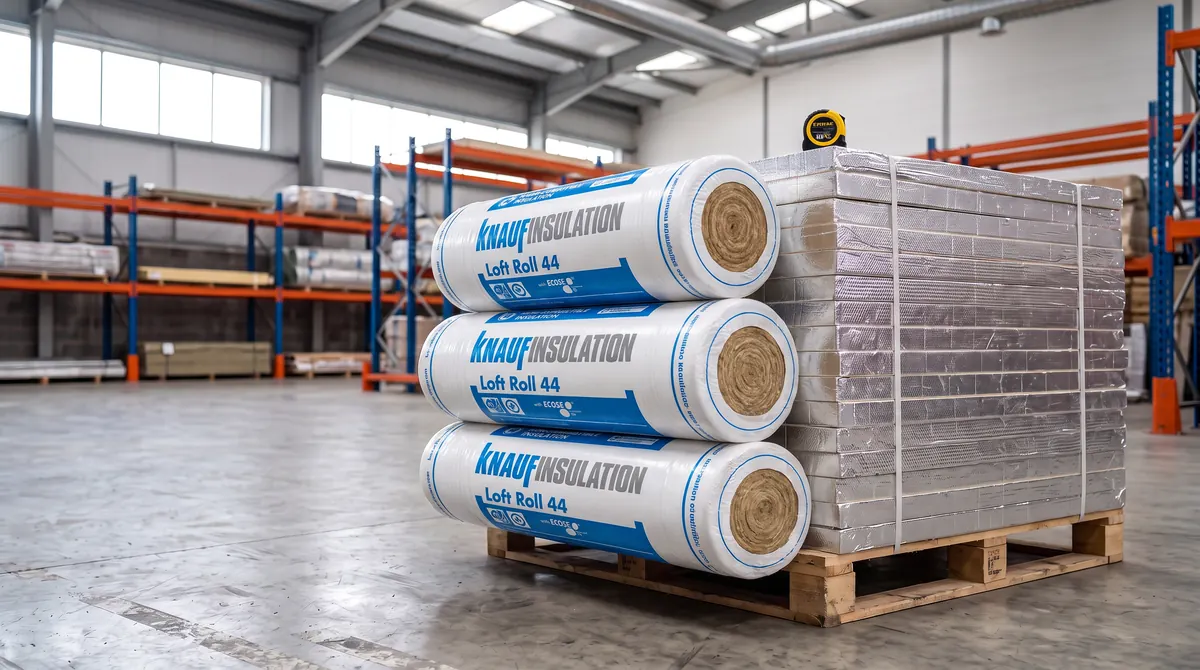
Illustration: loft insulation materials side by side
| Material | Best for | With storage |
|---|---|---|
| Mineral wool rolls | Almost every loft floor | Add a raised floor so it isn’t squashed |
| PIR boards | Shallow joists, low storage floors | Boards can go straight over the joists above |
| Blown fibre | Low, awkward or shallow-pitched lofts | Not suitable |
| Multifoil | Rooms in the roof, tight spaces | Loft floors get rolls instead |
| Recycled polyester | Lofts you use often | Raised floor, as with any roll |
| Sheep’s wool | Older homes, people who prefer natural materials | Raised floor, as with any roll |
Every material here goes on the loft floor except multifoil, which is fixed to the rafters only in rooms in the roof. We recommend one in your quote.
- Mineral wool rolls
- Mineral wool rolls are what most lofts get: laid between and across the joists to full depth. How it’s fitted, how deep, and with a storage floor.
- PIR boards
- Foil-faced PIR boards cut between the joists where depth is tight, such as under an existing boarded floor. When they make sense and how they’re fitted.
- Blown fibre
- Loose fibre blown across the loft floor where it’s too low or cramped for rolls. Where it suits, and why it doesn’t mix with storage.
- Multifoil
- Thin multifoil fixed to the rafters where a room in the roof needs insulation and headroom is precious. The only insulation we fit to rafters.
- Recycled polyester
- Polyester rolls made from recycled bottles: soft, itch-free and laid just like mineral wool. When it’s worth paying more for.
- Sheep’s wool
- Sheep’s wool rolls laid between and across the joists like any other roll. Good with moisture, nice to handle, and dearer than mineral wool.
Full depth below. Room to store above. Get a price.
Tell us about your loft and we’ll quote the insulation, boarding and ladder in writing. Free, no obligation.